Dollars for Rotterdam, Rifles for Java: The Marshall Plan’s Uncomfortable Indonesian Detour
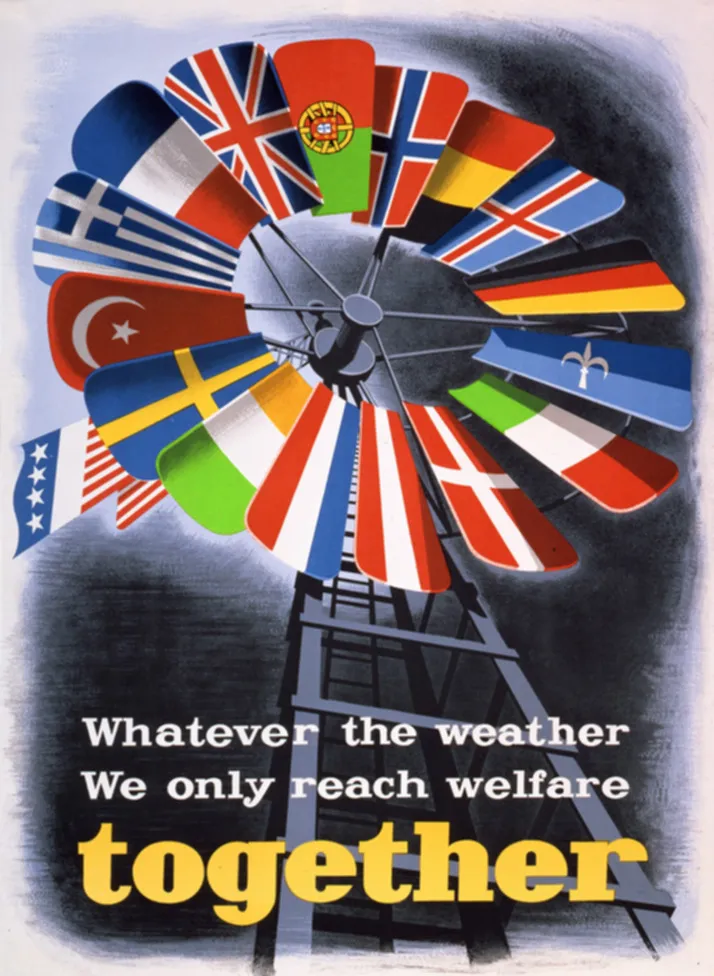
Photo: E. Spreckmeester (also credited as "I. Spreekmeester"), published Economic Cooperation Administration, Public domain, via Wikimedia Commons
The Marshall Plan is usually remembered in the United States as a clean, generous story: a battered Europe gets back on its feet, communism loses appeal, and American dollars buy stability without firing a shot. That story is not wrong. It is just incomplete. In the late 1940s, one of the plan’s major recipients was the Netherlands—a country that was simultaneously waging a colonial war in Indonesia. Washington had to face an awkward question: what do you do when your European recovery money helps free up resources for somebody else’s empire?
A Recovery Program With a Colonial Shadow
When the Marshall Plan began in 1948, the Netherlands was a natural candidate for help. Its economy had been wrecked by occupation and war. Rotterdam needed rebuilding. Dutch industry needed raw materials and credit. American policymakers wanted Western Europe stable, democratic, and resistant to Soviet influence. The Netherlands fit the bill.
But the Dutch state in 1948 was not just a small European country. It was still an imperial power. Indonesia had declared independence on August 17, 1945, but the Netherlands refused to accept it. What followed was a messy, violent struggle: Dutch military offensives, Republican guerrilla resistance, fragile cease-fires, and negotiations that kept collapsing. By the time Marshall Plan dollars started flowing, the Dutch were trying to rebuild their economy at home while fighting a war on the other side of the world.
Washington noticed. American officials were not anti-colonial crusaders by instinct. Many were comfortable with European empires in principle, especially if those empires seemed anti-communist. But Indonesia was not a side issue. It was huge, resource-rich, and strategically important. And the Indonesian nationalist movement was not going away.
The Accounting Problem
Here is where the story gets interesting. Did Marshall Plan aid directly pay for Dutch troops in Indonesia? Not in any simple, receipt-stamped way. The Dutch insisted the aid was for European recovery only, and American officials repeatedly said it must not be used for colonial operations. There were rules. There was paperwork. There were assurances.
But money is fungible. That is a fancy way of saying dollars do not wear labels. If American aid helped stabilize the Dutch budget and rebuild the Dutch economy, then Dutch resources were freed up for other things—including the military. The Netherlands could keep conscripting soldiers, shipping them to Southeast Asia, and paying for a colonial war that was growing more expensive by the month. American aid did not have to be loaded onto a plane bound for Java to make that war easier to sustain.
That was the blind spot. The Marshall Plan was designed for European recovery, but Europe’s empires were still entangled with European economies. American policymakers wanted a strong Netherlands in Europe. They did not want to be seen as bankrolling Dutch colonialism in Asia. Those two goals were harder to separate than the spreadsheets suggested.
The Second Police Action and the American Reckoning
The contradiction came to a head in December 1948. After months of stalled negotiations, the Dutch launched a second major military offensive, often called the second police action. Dutch forces captured Indonesian Republican leaders, including Sukarno and Hatta, and occupied Yogyakarta. The Dutch hoped for a quick, decisive win. Instead, they got international outrage.
The United Nations Security Council had already been involved in trying to broker a settlement. The new offensive made the Netherlands look like the obstacle to peace. In Washington, officials worried about several things at once. They worried about the United Nations. They worried about Asian opinion. They worried that Dutch stubbornness was handing propaganda victories to the Soviet Union. And they worried that a prolonged colonial war would push Indonesian nationalists toward the communist camp—or at least make them less friendly to the United States.
That last point mattered most in the Cold War calculus. The United States was not against empire in some abstract moral sense. It was against empire when empire became a strategic liability. By 1949, Dutch policy in Indonesia looked less like a stabilizing force and more like a recruitment tool for anti-Western sentiment across Asia.
Pressure, Not Principle
So Washington applied pressure. It was not always loud, and it was not always consistent. American officials did not want to humiliate a NATO ally. They did not want to fracture Western Europe’s recovery. But they had leverage: Marshall Plan aid, diplomatic support, and the Netherlands’ need for American goodwill.
The United States pushed the Dutch toward negotiations. It supported United Nations efforts. It made clear that continued aid and political backing were not unconditional. In 1949, with the Marshall Plan still underway and Dutch finances still fragile, Washington signaled that the Netherlands could not expect business as usual while it fought to retake Indonesia. The Dutch eventually agreed to a Round Table Conference at The Hague. That conference produced a transfer of sovereignty on December 27, 1949. Indonesia became independent—not because American policymakers had experienced a sudden change of heart about colonialism, but because the cost of backing the Dutch had become too high.
The Indonesian side did not win by diplomacy alone. Republican leaders, guerrilla fighters, and ordinary Indonesians had made the Dutch position untenable through years of resistance. The United States helped tip the balance. It did not create the outcome by itself.
What the Episode Leaves Behind
For American readers, the Marshall Plan’s Indonesian detour is a useful case study in the limits of aid as foreign policy. Aid can build schools, ports, and factories. It can also free up resources for purposes the donor never intended. The Netherlands was not stealing Marshall Plan dollars and shipping them to Java, but the overall effect was close enough to make Washington uncomfortable.
The episode also shows how Cold War priorities could bend principle. The United States did not oppose Dutch colonialism because colonialism was wrong. It opposed Dutch tactics because they were becoming strategically counterproductive. That is a less flattering story than the usual Marshall Plan narrative, but it is a more honest one.
And it has a contemporary echo. Whenever the United States sends aid abroad, critics ask whether the money will be used as intended. Supporters say aid is about stability and influence. Both sides are usually right. The Marshall Plan in Indonesia is a reminder that aid is never just an accounting exercise. It is a political act, and it can get entangled in wars the donor never meant to join.