The White Cake With a Passport: How Tempeh Traveled From Java to the American Health Food Aisle
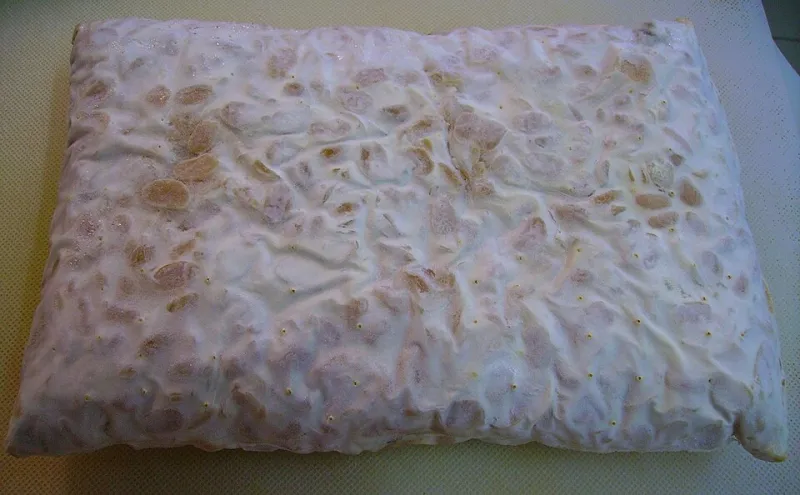
Photo: No machine-readable author provided. Timleo assumed (based on copyright claims)., CC BY-SA 3.0, via Wikimedia Commons
Tempeh does not look like a food that changes minds. It looks like a dense white cake of soybeans, sometimes freckled with dark specks, often sold in vacuum-sealed bricks beside tofu and seitan. In an American grocery store, it can seem like another product invented by a lab. But the food has a long, low-tech biography that begins in Java, where soybeans are fermented with a mold called Rhizopus and wrapped in banana leaves or plastic. The cake is everyday food, not a modern protein hack. Its route to the United States runs through migration, counterculture, and a very American talent for repackaging.
A breakfast food with a microbial engine
Tempeh is at least centuries old, and probably older than any written record that pins down its first kitchen. In Indonesian households, especially on Java, it is sliced thin, fried, braised in sweet soy sauce, or eaten with rice and sambal. The white bloom on the outside is not spoilage; it is the visible work of fermentation. The mold binds cooked soybeans into a patty and helps make the beans easier to digest. In that sense, tempeh is less a recipe than a relationship between people, beans, and a fungus.
That relationship traveled well because it was cheap. Soybeans were affordable, fermentation was simple, and the result kept for a while. Tempeh became a food of markets and home kitchens, not palaces. It was ordinary in the best way: reliable, filling, and easy to adapt.
From colonial ports to immigrant kitchens
Dutch colonists in the East Indies wrote about tempeh, but they did not turn it into a global commodity. It remained a local food with local rules. By the mid-20th century, Indonesian students, diplomats, and immigrants brought tastes and techniques to the United States, but tempeh was not waiting in the supermarket. It needed a translator.
The translator arrived in an unlikely form: young Americans looking for alternatives to processed food. In the 1960s and 1970s, macrobiotic communities became fascinated by whole grains, fermented foods, and Asian traditions. Tempeh fit the program. It was high in protein, it was fermented, and it could be made in a kitchen instead of a factory.
The macrobiotic detour
The American tempeh story is closely tied to communes, co-ops, and a certain back-to-the-land optimism. Groups such as The Farm in Tennessee helped popularize small-scale tempeh production. Writers and researchers William Shurtleff and Akiko Aoyagi studied Indonesian soy foods and published The Book of Tempeh in 1975, complete with recipes, starter methods, and production plans. Their work gave American cooks a bridge to the original foodways.
Early American tempeh was not always elegant. Batches could be inconsistent, and the mold could be fussy. But the food found a home in health food stores, where shoppers were already comfortable with tofu, yogurt, and sprouts. Tempeh was sold as a niche product for people who read labels and kept starter cultures in the fridge.
The health food aisle and the mainstream
For decades, tempeh stayed on the edge of the American plate. Then the plant-based boom changed the math. As more shoppers looked for meat alternatives, tempeh reappeared as a protein with a story. Whole Foods and other chains began stocking flavored varieties—smoky maple, sriracha, curry—designed for people who had never seen a banana leaf.
In 2026, tempeh is still a modest presence compared with tofu, but it is no longer exotic. It sits in the refrigerated section near the vegan cheese and the cold brew. The packaging often calls it an ancient food and a modern protein. Both claims are true, and both are a little amnesiac. The label rarely mentions the Javanese cooks who kept the technique alive, or the Indonesian immigrants who carried it across oceans.
What the aisle forgets
Tempeh’s American career is a reminder that food migration is rarely a straight line. A food can leave home, become a counterculture symbol, then return as a commodity with a new accent. The soybean cake did not infiltrate the health food aisle by itself. It was carried by people, adapted by communities, and marketed by companies that saw a market.
So the next time you see a vacuum-sealed brick of tempeh, look past the protein number. Remember the banana leaf, the mold, the Javanese kitchen, and the long chain of hands that turned a breakfast food into a passport. The white cake has traveled far, but it still carries its origins in its texture.