The Island That Was Sold Twice: How 1930s America Invented Bali
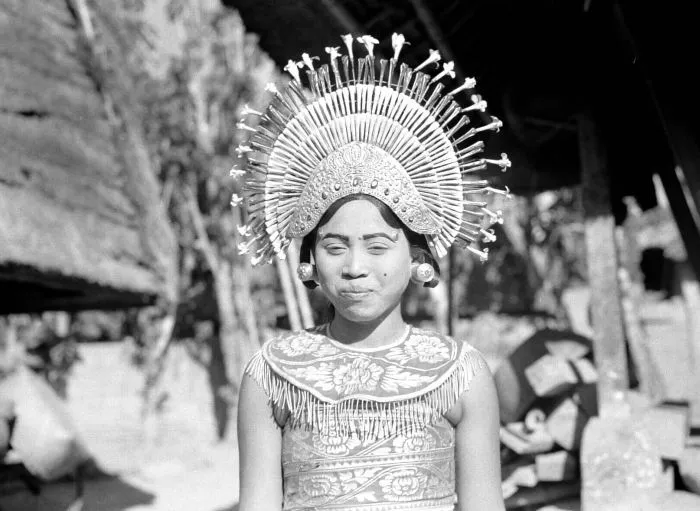
Photo: Unknown authorUnknown author, CC BY-SA 3.0, via Wikimedia Commons
If you walked into the Little Carnegie Playhouse in New York in the spring of 1932, you could buy a ticket to a documentary about Bali. What you got was something stranger: footage shot on the island by a Roosevelt cousin, cut together with a staged story of a love triangle, and marketed with a line that was honest about its own ambition — this, the ads said, is the picture that made Bali famous.
The film was called Goona-Goona: An Authentic Melodrama of the Isle of Bali. It ran for months. And in the space of a few years, an island most Americans could not have placed on a map became a shorthand for everything they thought they had lost at home.
The Roosevelt Who Went Looking for a Movie
André Roosevelt, a restless son of the extended Roosevelt family and a cousin of Theodore, went to Bali in the late 1920s with a camera and no script. He shot footage of temple ceremonies and dance performances, then partnered with Armand Denis to build something saleable around it: a fictional plot grafted onto real ritual.
The result was exactly the kind of hybrid that American audiences would come to trust and distrust at the same time. It looked like travelogue and behaved like melodrama. Critics noticed the seams. Moviegoers did not care.
The word goona-goona escaped the theater almost immediately. It became slang in the American press for a whole genre of pseudo-documentary exotic films — productions that promised authenticity and delivered atmosphere, usually with less clothing than the censor preferred and more invention than the credits disclosed.
The Dancers Who Redrew the Map
Before Hollywood got involved, Bali had already been photographed into legend on the other side of the Atlantic. The 1931 Colonial Exposition in Paris brought a Balinese gamelan and dance troupe to Europe, where the tuned gongs and the sharp, percussive Legong style landed on audiences that had never heard a scale like it.
American readers encountered the same performances secondhand, through magazines and reviews, and the descriptions did something to the language. Bali was not presented as a place with farms and tax collectors. It was presented as a mood: gongs in the dark, bare feet, and a civilization that had somehow survived modernity by refusing to arrive in it.
That framing traveled better than any factual account could have. It also traveled without the Balinese, who were mostly described rather than quoted.
The Cartoonist, the Composer, the Novelist
Three people did more than anyone to cement the American version of Bali, and only one of them was actually Balinese in their material.
Miguel Covarrubias, a Mexican-born illustrator whose caricatures ran in Vanity Fair and The New Yorker, went to the island in 1930 with his wife, the photographer Rosa Rolanda. His 1937 book Island of Bali was funny, observant, and genuinely researched — and it stayed in print for decades, becoming the book Americans handed each other when they wanted to understand the place.
Colin McPhee, a Canadian-born composer living in New York, sailed in 1931 and stayed off and on for years, transcribing gamelan orchestrations with a fanatic's patience. His 1936 piece Tabuh-Tabuhan put Balinese patterns into a Western concert hall, and his memoir A House in Bali fixed the image of the foreign artist absorbed into village life.
And Vicki Baum, the Austrian novelist who had already become a Hollywood screenwriter, published a Bali novel in 1937 that American book clubs embraced. Baum barely knew the island. She did not need to. By then the market for Bali did not require firsthand experience — it required atmosphere, and she was a professional at atmosphere.
Two Americans With Cameras
In 1936, Margaret Mead and Gregory Bateson arrived and stayed for the better part of three years, shooting tens of thousands of feet of film and photographic stills. Their project — using the camera as a research instrument to record child-rearing, gesture, and trance — was serious anthropology funded by American institutions.
It was also, unavoidably, exoticism with a research budget. Their footage selected for intensity: the trance states, the theatrical drama, the visual surprises. The parts of Balinese life that looked like a working economy in a colonial territory did not make the final cut.
Their archive still exists, and it is genuinely valuable. It is also a reminder that documentation and mythmaking are not opposites. Sometimes they travel in the same camera bag.
What the Fantasy Left Out
Bali in the 1930s was not untouched, and it had not been for a generation.
The Dutch had completed their conquest of the island by 1908, after the disastrous puputan surrenders at Badung and Klungkung in which royal courts marched into gunfire rather than submit. By the 1930s, the island was administered, policed, and actively marketed by a colonial government that understood exactly what tourists wanted to buy.
A modern hotel had already opened in Denpasar in 1928, run with shipping-line money. The global Depression then wrecked the island's copra and rice revenues and pushed more Balinese toward the cash economy that tourism offered — performing, guiding, selling, posing.
Even the most iconic Balinese art form Americans associate with timeless tradition was being assembled in this period. The kecak, the chanted monkey-dance performed by a large circle of men, was developed in the 1930s with the involvement of the German artist Walter Spies and the Balinese performer Wayan Limbak, drawing on older trance ritual and shaped, from the beginning, partly for outsiders with cameras and tickets.
That does not make it fake. It makes it a creation — which is what living cultures produce. It simply is not the unbroken, uncontacted inheritance the travel brochures were selling.
Why the Picture Never Quite Fades
The 1930s version of Bali proved so durable that it outlived every correction. It became a Broadway lyric and then a movie. It became a honeymoon destination, then a wellness destination, then a laptop-on-the-beach destination.
Each era renames the fantasy. The structure does not change: a place is described in the vocabulary of what the visitor lacks — simplicity, authenticity, ease — and the people who live there are folded into the scenery.
The 1930s filmmakers were not villains, and the artists who fell for the island were often sincere. But they were selling as much as they were seeing, and the island they sold has been cashing the check ever since.