The Frigate at the Pepper Port: America's First Fight in Southeast Asia
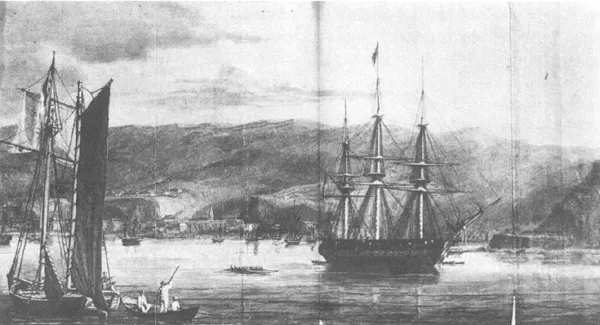
Photo: Unknown, Public domain, via Wikimedia Commons
On the morning of February 6, 1832, a United States frigate lay at anchor off a small pepper port on the northwest coast of Sumatra, waiting for the sun to come up over its own landing party.
The frigate was the USS Potomac, rated at 44 guns. The port was Kuala Batu, in Aceh. The men in the boats were American sailors and Marines, dressed in Malay clothing and paddling captured prahus. They hit the beach shortly before dawn, took the town's three stockades one after another, and fought their way through the streets before the defenders could organize.
It was the first time the U.S. Navy fought a battle in Southeast Asia. Perry's Japan was still twenty-one years away. Manila Bay was sixty-six years away. Da Nang was a hundred and thirty-three years away. Almost nobody in the United States remembers it happened.
A Trade Built on Pepper
To understand why an American warship turned up in Aceh in 1832, you have to start in Salem, Massachusetts.
In the decades after the Revolution, Salem's merchants built a durable business hauling Sumatran pepper back to American kitchens. The pepper was grown in the highlands, brought downriver, and sold through a string of small coastal towns run by local rajas — men who owed loose allegiance to the Sultan of Aceh but who negotiated their own deals, collected their own tolls, and enforced their own customs.
Those deals were mostly handshake arrangements made by the captains themselves. There was no American consulate in the neighborhood, no permanent navy squadron in East Indian waters, and very little anyone in Washington could do about a dispute ten thousand miles from the Potomac. For twenty years, the system worked because it was profitable for both sides — and because nobody had yet had a bad enough day to make a case out of it.
In early February 1831, that changed.
The Taking of the Friendship
The Friendship was a Salem brig loading pepper at Kuala Batu under a captain named Charles Endicott. While she sat in the roadstead, a party came aboard — accounts differ on whether they arrived as traders or as raiders — seized the vessel, killed three members of the crew, and stripped the hold of opium and Spanish dollars worth tens of thousands of dollars.
Endicott and the survivors got the ship back with help from other American vessels nearby and sailed her home. The story landed in American newspapers in the way such stories do: a flag insulted, a crew murdered, a cargo stolen from honest merchants. The Jackson administration ordered the Navy to respond.
There was no American fleet in the East Indies, so the Navy sent one ship. The Potomac left New York in August 1831 under Commodore John Downes, rounded the Cape of Good Hope, and arrived off Sumatra roughly six months later.
Orders That Left Room
Downes's instructions were narrower than what he actually did. He was told to punish the parties responsible for the Friendship affair and to secure compensation — but also to avoid turning a punitive strike into a general war with the coastal towns. The distinction mattered, because the coastal towns had very little to do with one another.
What Downes found at Kuala Batu was a fortified settlement that had already heard he was coming. He chose a full assault rather than a blockade or a negotiation, and he chose surprise. The landing force — roughly 280 sailors and Marines — went ashore in local boats, in local dress, and hit the stockades before daylight.
The defenders fought hard and lost. American casualties were light: two killed, about a dozen wounded. The toll on the town was far heavier — probably over a hundred dead, and most modern accounts agree that a large share of them were noncombatants. The Potomac went on to a second settlement, extracted promises and payment, and then sailed away.
The Treaty Nobody Remembers
Before leaving the region, Downes and the local rulers concluded an agreement: free trade, protection for shipwrecked sailors, an end to the seizures. It was signed with the rajas of the coast, not with the Sultan of Aceh, and not in consultation with the Dutch, who by then claimed the whole of Sumatra as their sphere and had a garrison at Padang on the other side of the island.
The Americans had dealt with whoever was actually in the room. That was practical in 1832. It was also the reason the agreement did not hold.
Six years later, another American merchant ship, the Eclipse, was seized in the same waters. In 1838, two U.S. warships returned and bombarded Kuala Batu again, this time with even less ceremony. The pattern was already set: a commercial grievance, a punitive expedition, a treaty with a local power, and a repeat performance a few years later once the treaty had quietly stopped meaning anything.
A Template, Whether or Not Anyone Called It One
It would be a stretch to say the officers of 1832 sat down and designed a playbook for the next century and a half. They were solving a problem about pepper.
But read forward, the shape of the thing is hard to miss: force projected unilaterally to protect commerce; a settlement punished as a collective rather than an individual; a deal signed with whoever held the beach instead of whoever held the sovereignty; and a public back home that accepted all of it because the alternative was to look weak in a distant place it could not name.
Aceh itself never dropped off the map. In 1873 the Dutch invaded in earnest, beginning a war that lasted decades and killed enormous numbers of people. By then the American pepper trade had moved on, and the Sumatran coast had become someone else's long, grim story.
What Survives in the Archive
The 1832 expedition lives on mainly in logbooks, ships' papers, and a handful of memoirs — the kind of material that sits in maritime collections in Salem and Washington and is consulted by specialists. There is no monument, no holiday, no popular paperback.
Which is a little strange. The United States had no colonial empire in Asia in 1832, no bases, no fleet, and no doctrine. It had a frigate, a grievance, and a distance it was willing to cross. Everything that came later was built on top of that first willingness — and the Potomac got there first, eight years before anyone thought to sail into Tokyo Bay.