Soft Power on Shifting Ground: The Peace Corps in Sukarno's Indonesia
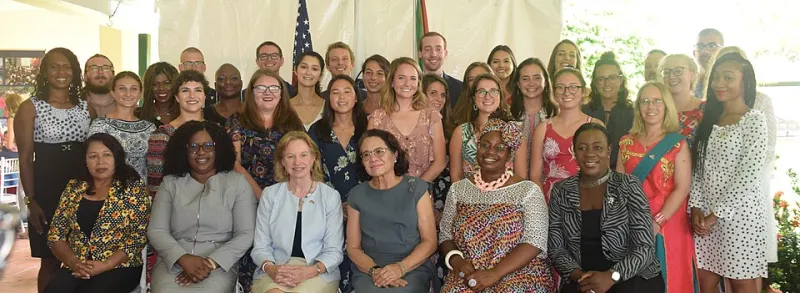
Photo: U.S. Embassy Guyana, Public domain, via Wikimedia Commons
The Peace Corps was barely a few months old when Indonesia became one of its earliest assignments. In Washington, the program looked like a clean idea: send idealistic young Americans abroad to teach, build, and listen. In Jakarta, President Sukarno's government had its own reasons to say yes. A visible American presence could help a nonaligned country play both sides of the Cold War. For a while, the arrangement suited everyone. Then the ground shifted.
A Welcome Mat With Strings Attached
The first volunteers reached Indonesia in the early 1960s, part of a wave that would grow into the hundreds. They were assigned to schools in Java, Sumatra, and beyond, mostly teaching English, science, and physical education. The pitch was simple. Americans would share skills, learn about Indonesia, and return home with a more complicated picture of the world. Indonesian officials, meanwhile, could point to the program as evidence that Jakarta was not choosing sides in the great rivalry between Washington and Moscow.
That balancing act was always fragile. Sukarno had built his political career on anti-colonial rhetoric and on the idea that newly independent nations should chart their own course. He welcomed Peace Corps teachers, but he did not welcome American pressure. Embassy memos from the period show a constant tug-of-war over appearances. Washington wanted the volunteers to be seen as friendly and apolitical. Jakarta wanted them to be useful without becoming too visible. The volunteers themselves were caught in the middle, often without realizing it.
Lessons in a Language They Barely Spoke
On paper, the job was teaching. In practice, it was an education in improvisation. Many volunteers arrived with only a few months of Indonesian language training. They were dropped into towns and villages where the local language might be Javanese, Sundanese, or something else entirely. Schools lacked books, maps, and sometimes desks. Local teachers had their own methods, often built around memorization and recitation. The young Americans came in with games, group work, and songs, which sometimes delighted students and sometimes baffled colleagues.
Letters home from the period, later quoted in histories of the program, describe a daily life that was equal parts exhausting and exhilarating. Volunteers learned to eat rice at every meal, to bathe from a mandi, and to accept that their carefully prepared lesson plans might collapse because the electricity had gone out. Some found deep friendships with host families. Others struggled with loneliness and with the suspicion that they were being watched. In a country where the political atmosphere was thickening, even a volunteer teaching the alphabet could look like a symbol.
The Politics That Wouldn't Stay Outside the Classroom
By the mid-1960s, Indonesia's relationship with the West was deteriorating. Sukarno had launched a campaign against the formation of Malaysia, which he viewed as a British-backed colonial scheme. The confrontation, known as Konfrontasi, put Indonesia on a collision course with Britain and its allies. At the same time, Sukarno moved closer to China and radicalized his domestic rhetoric. Anti-American demonstrations became more common. Communist and nationalist groups accused the Peace Corps of being a front for intelligence gathering.
The accusation was not new. Throughout the Cold War, host governments sometimes suspected that volunteers were spies. In Indonesia, the charge gained traction. Embassy cables from Jakarta describe a government increasingly sensitive to foreign influence and a public mood that could turn quickly. Volunteers reported being questioned about their motives. Some local officials began to keep their distance. The program that had been sold as a bridge was now being described as a leak.
The Exit
In 1965, the Indonesian government ordered the Peace Corps out. The decision came amid a broader rupture with Washington and a wave of anti-American sentiment. Volunteers packed up classrooms and said goodbye to students and host families. Some left with regrets. Others left with relief. The program had lasted only a few years, but it had put hundreds of young Americans in direct contact with a country that most of them had known only through headlines.
For Washington, the end of the Indonesia program was a small but telling defeat. The Peace Corps had been designed to show that the United States could be a helpful partner rather than a distant power. In Indonesia, that message ran into the hard realities of nationalism, sovereignty, and suspicion. Soft power, it turned out, could open doors. It could not control what happened once those doors were open.
What Goodwill Could Not Do
The Peace Corps would not return to Indonesia for years. When Americans later looked back on the experiment, they often remembered the classrooms and the friendships more than the politics. But the politics were never far away. The volunteers had arrived in a revolutionary country at a moment when neutrality was becoming impossible. They had tried to teach English and science, and they had ended up learning something harder: that good intentions are not a policy, and that a country's idea of itself can matter more than any foreign visitor's lesson plan.
That lesson still resonates. The Peace Corps has long sold itself as a form of people-to-people diplomacy, a way to build trust one classroom at a time. The Indonesian episode shows both the promise and the limit of that approach. Volunteers can change individual lives. They cannot change the direction of a nation that has decided the West is not on its side. In Sukarno's Indonesia, the young Americans learned that the hard way.