The Summer That Never Showed Up: How Tambora Froze New England's Fields
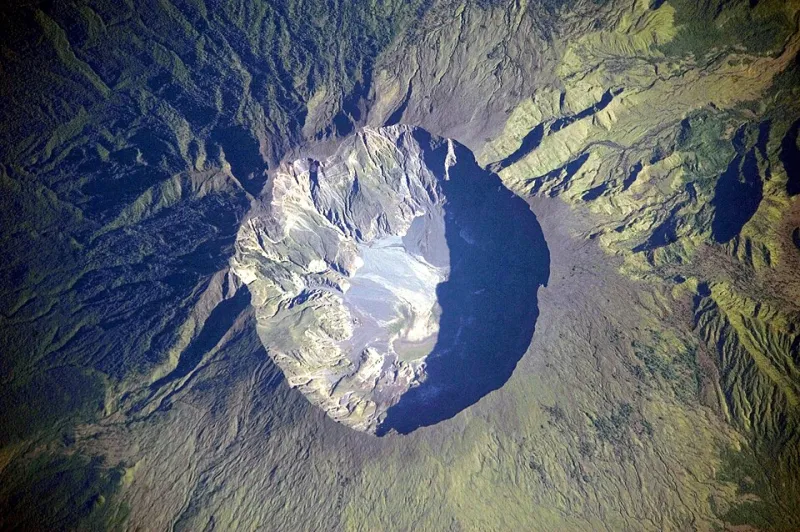
Photo: This image was taken by the NASA Expedition 20 crew., Public domain, via Wikimedia Commons
On the evening of April 5, 1815, people in the town of Bima, on the island of Sumbawa in what is now Indonesia, heard what sounded like distant cannon fire. Nobody had a satisfying explanation. Five days later the noise returned, louder, and this time it came with a column of ash that blotted out the sky for a two-day drive in every direction.
Mount Tambora, a 14,000-foot peak that had been quiet for centuries, had torn itself apart. It is still the largest eruption in recorded history — bigger than Krakatoa in 1883, bigger than any blast since, and the reason some Vermont farmers woke up on a June morning in 1816 to find snow on their fields.
A Kingdom Buried in Ash
The eruption's climax came on April 10 and 11. Pyroclastic flows raced down the mountain at hundreds of miles an hour and buried the Tambora kingdom, a small polity whose name survives today mostly because it was obliterated. Archaeologists working in 2004 uncovered a pair of bronze figures and charred remains preserved the way Pompeii was preserved, and the site has since been nicknamed the Pompeii of the East.
The immediate death toll on Sumbawa is usually estimated around 10,000 people, most of them killed by the flows and falling debris. The longer catastrophe was famine: ash smothered rice fields across the region, livestock died, and drinking water turned foul. Including starvation and disease in the following months, the toll across Sumbawa and neighboring Lombok is often put near 100,000.
A related loss was linguistic. The Tambora language, an isolate recorded by British officials in the few years after the eruption, disappeared with its speakers. Only word lists survive, collected by the colonial administration of the day — a reminder that when a mountain kills a community, a whole vocabulary can go with it.
What Went Up Came Down Everywhere
The eruption threw an enormous volume of sulfate aerosols into the stratosphere. Those particles are tiny, but they are excellent at bouncing sunlight back into space. Global average temperatures dropped by somewhere around half a degree Celsius — trivial-sounding, and wildly consequential at the margins of a growing season.
1816 became the coldest summer in the Northern Hemisphere in centuries. In New England, the trouble announced itself on June 5, when a cold front dropped temperatures fast enough that snow fell across Vermont, New Hampshire, and parts of Massachusetts. Crops that had been planted in spring were cut down. Farmers replanted. Frosts came again in July and August, and in some high valleys in September.
"Eighteen Hundred and Froze to Death"
New Englanders gave the year nicknames that sound like jokes and were not: Eighteen Hundred and Froze to Death, and The Poverty Year. Corn — the staple of the northern farm — will not tolerate a hard frost, and the harvest across much of the region failed. Oats and hay failed with it. Grain prices spiked, meat prices followed, and families that had been one bad season away from disaster found themselves there.
It was not an American-only event. Europe had it worse in places: bread riots in Britain and France, food shortages across the continent, and a grain crisis that shaped politics for years. The disaster was genuinely global, one of the first such events in which telegraph-free societies on three continents found themselves responding to the same bad weather.
Why It Pushed Settlers West
The 1816 harvest failure is one of the reasons New Englanders went west in such numbers in the years that followed. Farm families from Vermont, New Hampshire, and upstate New York — already squeezed by thin soil and rising land prices — looked at another failed season and made a decision their grandparents might have deferred. Ohio, Indiana, Illinois, and Michigan were suddenly worth the wagon trip.
Historians are careful about the weight they put on any single year, and rightly so. Migration out of New England was already underway before Tambora. But the 1816-1817 exodus was dramatic, and the timing shows up in county records across the Midwest. The first wave of New England settlement in the Western Reserve of Ohio and the "Yankee" towns of northern Illinois grew noticeably in exactly those years.
The infrastructure followed. The Erie Canal, begun in 1817 and finished in 1825, made the trip west from New York cheap enough for ordinary families — a case of geology, climate, and engineering arriving in the same decade.
One small footnote with a long afterlife: in 1816, the family of a Vermont farmer named Joseph Smith Sr. lost their farm in Norwich and relocated to Palmyra, New York. The religious movement their son later founded grew out of that New York chapter.
Geneva, June 1816: Ghost Stories by a Cold Fire
The summer's most famous cultural artifact came from Switzerland. Mary Godwin — later Mary Shelley — was staying at the Villa Diodati on Lake Geneva with Percy Shelley, Lord Byron, and Byron's physician John Polidori. June 1816 was cold and relentlessly rainy, with weather bad enough that the group stayed indoors for days.
Byron proposed a ghost-story competition. Shelley produced Frankenstein, Polidori produced The Vampyre — the first modern vampire tale in English — and Byron himself wrote the poem Darkness, an apocalyptic vision of a world where the sun goes out. Readers have argued ever since about how much the strange sky did to the writing. Weather records from Geneva that June are not ambiguous: it was genuinely miserable.
What Tambora Teaches From Here
Two centuries on, the practical lessons have shifted. Volcanologists now monitor Indonesian peaks closely, and the country's geological agency publishes real-time bulletins on dozens of mountains. The 2010 eruptions of Eyjafjallajökull in Iceland grounded European air travel for days, a reminder that the atmosphere still moves our lives around on short notice.
But the most useful takeaway is a food-system one. In 1816, a harvest failure in New England meant a family sold the farm. Today, a shock that size would travel through shipping lanes, futures markets, and grain reserves instead. Whether that makes us safer or simply more dependent on a system with no backup farm is a fair question to ask while looking at a photograph of a crater in Sumbawa.
The mountain is still there. Its summit is lower than it used to be, and the caldera is six miles across.