Last Waltz in the Sunda Strait: The Night a Texas Cruiser Became an Indonesian Ghost Story
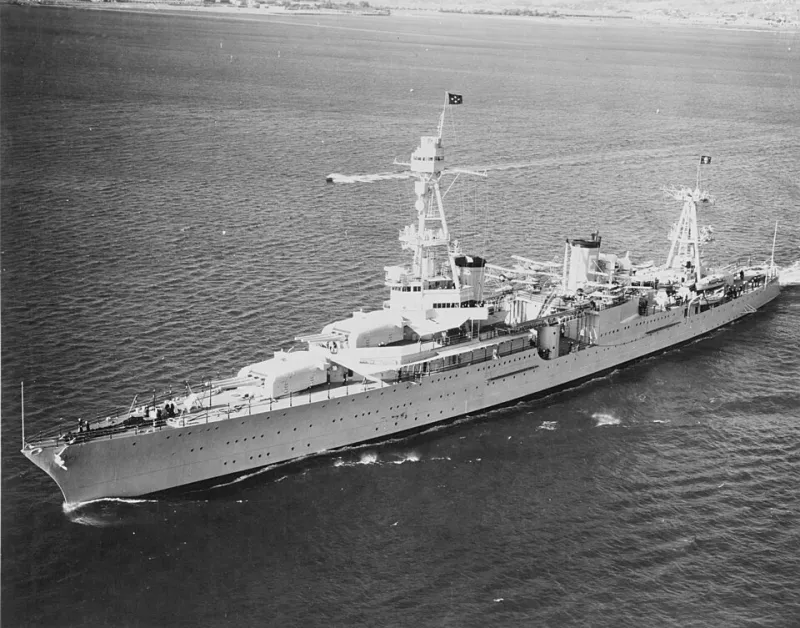
Photo: U.S. Navy, Public domain, via Wikimedia Commons
Shortly after midnight on 1 March 1942, a heavy cruiser with a Texas name and a White House guest list behind it rolled over and went down in the Sunda Strait, between Java and Sumatra. The ship was the USS Houston, and the men who survived the sinking spent the next three and a half years in Japanese prison camps, many of them building railways through the islands they had once visited on shore leave. The battle itself lasted barely an hour. The afterlife of that hour has lasted eighty-four years.
What makes the story strange is how thoroughly it has been filed away in the United States. Pearl Harbor gets the headlines, Midway gets the movies, and the desperate four-nation defense of the Dutch East Indies gets a footnote in most survey courses. In Indonesia, the same night is remembered differently: as one of the closing scenes of colonial rule, when the sea between Java and Sumatra briefly belonged to nobody.
A Showboat That Went to War
The Houston was a Northampton-class heavy cruiser commissioned in 1930 and sent straight into the role of flagship for the US Asiatic Fleet. It was, by any measure, a glamorous assignment. Franklin Roosevelt sailed on her more than once, and the crew leaned into the nickname that came with it: the president's yacht. Between drills, the ship made the rounds of Southeast Asian ports, and Batavia was a favorite stop.
Survivor accounts from the prewar years read like outtakes from a musical. Sailors remembered orchestras at the Hotel des Indes, the clink of gin glasses, taxi rides down tree-lined canals, and batik shirts bought for girlfriends back in California. The Houston's band reportedly picked up local tunes. For a generation of American sailors, Java was not a map reference in a war plan. It was a place with dance floors.
That is the part most histories skip, and it is the part that makes the ending land harder.
Ninety Minutes in the Strait
By late February 1942, the Japanese advance had swallowed Malaya, Singapore, and most of the outer islands. The Allied command in the region, a short-lived arrangement of American, British, Dutch, and Australian forces, was coming apart at the seams. On 27 February the combined fleet was mauled at the Battle of the Java Sea, losing the Dutch cruisers De Ruyter and Java and most of its commander's confidence. The Houston took a hit that knocked out a turret and killed dozens of men.
With the sea route south closed, the Houston and the Australian light cruiser HMAS Perth were ordered to slip west through the Sunda Strait. They ran into a Japanese invasion convoy unloading in Banten Bay, on Java's western tip, and then into the warships guarding it. Torpedoes came from multiple directions. Perth went down first. Houston kept firing until the water took her, sometime around half past midnight. Captain Albert Rooks went down with the ship and was awarded the Medal of Honor posthumously.
Roughly 368 of the Houston's crew of about 1,060 survived the sinking. They swam into a strait full of oil, wreckage, and Japanese sailors, and were pulled out as prisoners.
What the Coast Remembered
The wreck lies in about forty meters of water, close enough to the Java shore that local fishermen have long known roughly where it sits. In 2014 a joint American-Indonesian survey confirmed the site. Then came the reports that have soured the story: divers and salvagers stripping the wrecks of the Houston, the Perth, and the British ships Exeter and Encounter for scrap metal, using lifting gear and barges. Indonesia's navy promised patrols. The scavenging did not fully stop, and the three Allied governments have protested more than once.
On the Java coast, the Houston has also settled into folklore. Fishermen spin yarns about a ghost ship that appears in the strait on dark nights, guns blazing at nothing. You do not have to believe any of it to see what it is: a way of holding onto a night that official history mostly ignored.
The Railway and the Long Road Home
For the survivors, the war was only beginning. Most were held first at the Bicycle Camp in Batavia, then shipped to Singapore, Burma, Sumatra, or Japan. They worked on the Burma-Thailand railway, on the brutal Pakanbaroe line across Sumatra, in mines and docks. Disease and malnutrition did what the torpedoes had not. Hundreds of Houston men died in captivity, including many in the holds of Japanese transport ships torpedoed by American submarines that had no way of knowing who was aboard.
Liberation in 1945 came in stages and in the wrong uniforms, with the Dutch trying to resume colonial control and Indonesian nationalists already declaring a republic. Some Houston veterans later said the strangest part of going home was explaining where they had been. Nobody in Houston, Texas, knew what the Sunda Strait was.
Why the Textbooks Skipped It
There are practical reasons. The battle involved four navies, several languages, and a chain of command that dissolved as it was being attacked. It ended in defeat, which is harder to sell than an island assault. And the setting, the Dutch East Indies, has always been awkward in American memory: a colonial possession, not a nation, at least as Washington saw it at the time.
But Indonesia remembers. The wreck sites have become something close to heritage sites on the Java coast, and joint memorial services draw both diplomats and descendants. In Houston, a monument in a downtown park and a dedicated survivors' association kept the flame going while the textbooks looked elsewhere.
The next big anniversary falls on 28 February 2027, eighty-five years after the last shots. It would be a decent moment for an American history class to spend ten minutes on the Java Sea. The men who danced in Batavia and died in the Sunda Strait were not fighting for a colony or a textbook chapter. They were fighting because the order came, and because the ship next to them was an Australian one.